Fruit-Juice Co-Fermentation in Coffee
Microbial Ecology, Metabolism, and Chemical Consequences
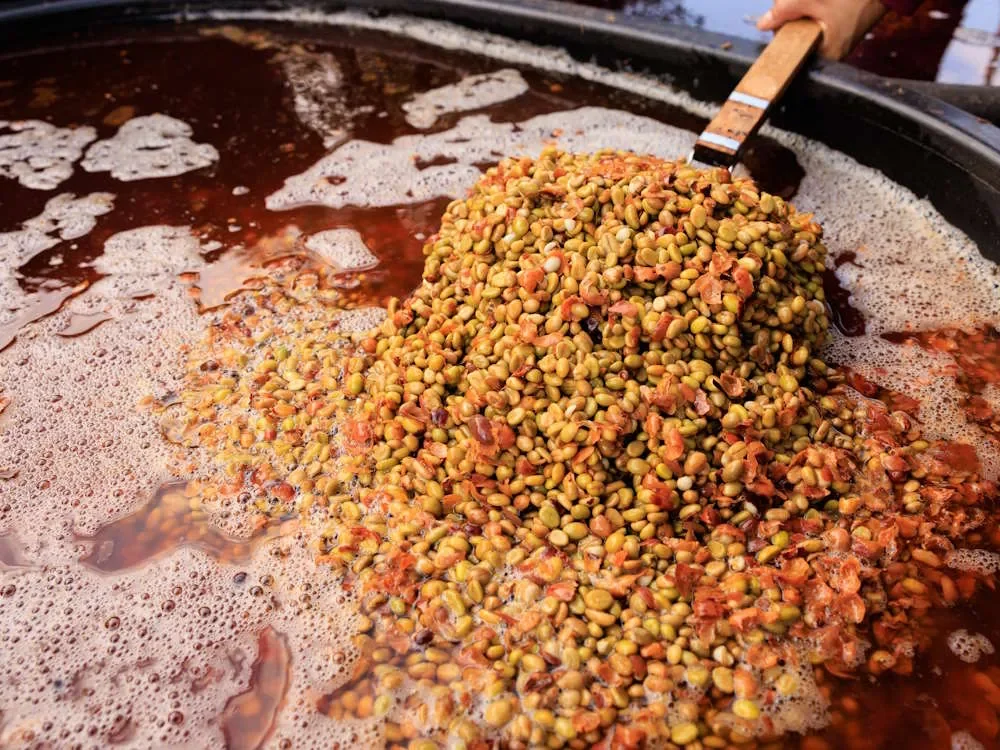
1. What is Fruit Juice Co-Fermentation in Coffee?
Fruit-juice co-fermentation is a substrate-driven fermentation intervention in which coffee cherries (or depulped parchment) are fermented in the presence of exogenous fruit juice (e.g., pineapple, passionfruit, grape, mango, citrus). Unlike simple flavor infusion, the juice acts as a nutrient and microbial modifier, fundamentally altering the fermentation ecosystem rather than merely adding aromatic compounds.
From a microbiological standpoint, fruit-juice co-fermentation is best understood as environmental selection pressure applied to the native coffee microbiome.
2. Baseline: The Microbial Ecology Behind Fruit-Enhanced Fermentation
In spontaneous coffee fermentations, microbial succession typically follows this pattern:
Early phase (0–24 h)
Dominated by osmotolerant yeasts (Hanseniaspora, Pichia, Candida)
Rapid sugar consumption → ethanol, CO₂, esters
Mid phase (24–72 h)
Increase in lactic acid bacteria (LAB) (Lactobacillus, Leuconostoc)
Acidification via lactic acid production
Late phase (>72 h)
Possible rise in acetic acid bacteria (AAB) (Acetobacter) if oxygen is present
Risk of excessive acetic acid and spoilage
This succession is driven by mucilage composition, primarily glucose, fructose, pectins, and limited nitrogen sources.
3. How Fruit Juice Alters the Fermentation Substrate
Fruit juice dramatically changes the chemical landscape of the fermentation medium which in our case is coffee.
3.1 Sugar Profile Modification
Fruit juices introduce:
Higher simple sugar concentrations
Altered glucose:fructose ratios
Additional sugars (e.g., sucrose, maltose in some fruits)
This favors fast-growing, highly fermentative yeasts, often accelerating ethanol and ester production.
3.2 Organic Acids and pH Effects
Fruit juices contain intrinsic acids:
Citric (citrus, pineapple)
Malic (apple, grape)
Tartaric (grape)
Ascorbic (many tropical fruits)
These acids lower starting pH, often to 3.0–4.0, which:
Suppresses spoilage bacteria
Favors acid-tolerant LAB (Lactic Acid Bacteria - are primarily responsible for a sour, tangy, or acidic flavour)
Alters enzyme activity and fermentation kinetics (the study of the rates at which microorganisms grow, consume substrates (like sugar), and produce metabolites (such as alcohol or acids) during a fermentation process)
3.3 Nitrogen and Micronutrients
Juices supply:
Free amino nitrogen (FAN)
Vitamins (B-complex)
Minerals (K⁺, Mg²⁺)
These nutrients remove growth limitations commonly seen in coffee mucilage alone, increasing microbial metabolic intensity.
Microbial metabolic is the set of essential biochemical reactions microorganisms use to obtain energy and nutrients for survival, growth, and reproduction
4. Microbial Community Shifts in Fruit-Juice Co-Ferments
4.1 Yeast Dominance and Selection
Fruit juice strongly selects for:
Saccharomyces cerevisiae - a species of single-celled budding yeast (fungus) vital to human history, acting as the primary microorganism in baking, brewing, and winemaking for thousands of years
Torulaspora delbrueckii - is a beneficial non-Saccharomyces yeast widely used in winemaking, brewing, and baking to improve aroma, enhance complexity, and increase resistance to fermentation stress.
Pichia kluyveri - a non-Saccharomyces yeast widely found in nature and commonly used in the wine and beverage industries to enhance aroma, particularly by producing high levels of esters and thiols.
These yeasts:
Rapidly dominate due to sugar abundance
Outcompete indigenous non-fermentative species
Produce higher concentrations of volatile esters (ethyl acetate, isoamyl acetate, ethyl hexanoate)
This explains the pronounced tropical fruit, candy, and floral aromatics often associated with these coffees.
4.2 Lactic Acid Bacteria Amplification
LAB populations increase due to:
Lower pH tolerance
Access to yeast-derived metabolites (ethanol, amino acids)
Fruit-juice co-ferments often show dominance of:
Lactobacillus plantarum
Lactobacillus fermentum
These strains:
Convert sugars and malic acid into lactic acid
Produce soft acidity and enhanced mouthfeel
Reduce sharp citric acidity via malolactic-like pathways
4.3 Suppression of Undesirable Microbes
Low pH + rapid yeast dominance:
Limits Enterobacteriaceae - a large, diverse family of Gram-negative, rod-shaped bacteria that commonly inhabit the intestines of humans and animals.
Reduces mold risk
Suppresses excessive acetic acid bacteria (unless oxygen is abundant)
This partially explains why fruit-juice ferments can be microbiologically stable despite high sugar loads.
5. Metabolic Pathways Enhanced by Fruit Juice
Metabolic pathways are interconnected series of chemical reactions, catalyzed by specific enzymes, that occur within cells to maintain life
5.1 Esterification Explosion
High ethanol + abundant organic acids = enhanced ester synthesis:
Ethanol + acetic acid → ethyl acetate (fruity, solvent-sweet)
Ethanol + hexanoic acid → ethyl hexanoate (pineapple, apple)
Higher alcohols + acids → complex floral esters
These compounds bind to the green bean matrix and persist as aroma precursors through roasting.
5.2 Amino Acid Transformation
Fruit juice increases:
Leucine - an essential branched-chain amino acid (BCAA) crucial for muscle protein synthesis, tissue repair, and energy regulation
Valine - an essential branched-chain amino acid (BCAA) required for human health,, aiding muscle growth, energy production, and tissue repair
Phenylalanine - an essential amino acid—a building block of protein—that the human body cannot produce on its own and must obtain through diet, such as meat, fish, eggs, and dairy.
These amino acids:
Are metabolized by yeasts into higher alcohols
Become key Maillard and Strecker precursors during roasting
Intensify sweetness, body, and aromatic complexity
5.3 Acid Metabolism and Buffering
LAB activity modifies acidity by:
Converting malic → lactic acid
Producing short-chain fatty acids
This leads to:
Perceived sweetness
Reduced sharpness
More “round” acidity despite lower pH
6. Penetration into the Coffee Seed
While fermentation occurs externally, research shows that:
Small organic acids
Alcohols
Volatile precursors
Diffuse through the parchment and silverskin into the endosperm. This diffusion is enhanced by:
Extended fermentation time
High osmotic pressure from sugars
Osmotic pressure is the minimum pressure required to stop the inward flow of a solvent (usually water) across a semipermeable membrane into a more concentrated solution. It acts as a "pulling" force proportional to the solute concentration and temperature, determining how water moves to balance concentrations in biological and chemical systems.
Ethanol-mediated membrane permeability
Ethanol-mediated membrane permeability refers to the increased, often uncontrolled, passage of ions, molecules, and fluids across biological membranes (cell plasma membranes, mitochondrial membranes) caused by the exposure to ethanol.
This is why fruit-juice co-fermentation changes the intrinsic chemistry of the bean, not just surface flavor.
7. Why Fruit-Juice Co-Ferments Taste “Intense”
From a scientific standpoint, intensity comes from:
Higher total volatile concentration
Greater ester diversity - esters contributes to a more complex, nuanced, or complex aroma and taste profile,
Elevated precursor pools for roasting reactions
This creates sensory clarity, not just novelty.
8. Risks and Limits
Fruit-juice co-fermentation carries risks if poorly controlled:
Excessive ester formation → artificial or solvent-like notes
Over-acidification → hollow or sour cups
Inconsistent microbial dominance → batch variability
These outcomes stem from unmanaged microbial overactivity, not the juice itself.
Final Thoughts: Fruit Juice as a Microbial Steering Tool
Fruit-juice co-fermentation is best understood as microbial ecosystem engineering, where:
Juice = altered substrate chemistry
Chemistry = microbial selection
Microbes = targeted metabolite production
Metabolites = modified green coffee chemistry
Rather than “adding fruit flavor,” fruit juice reshapes microbial metabolism, creating a biochemical pathway that permanently alters how the coffee develops flavor.
By no means as you conclude this article, should you be lead to believe this is a championing of the new and unexplored. Or denergrating of the old and classically refined.
But take this as a informative piece of writing to educate and bring further transparency to a style of coffee processing that is fresh and novel to many who only understand the surface level as I did before writing this.
What I find most intriguing about this approach - is how reshaping microbial metabolism, creating biochemical pathways be taken further in the coming years.
It opens so many avenues of exploration - that it’s truly hard to comprehend where the limitations of this truly ends.